Melee Game Design Path Forward?

Saephis

Virtuous
Hello There (Again)!

I know this may be opening a can of worms, and this probably belongs on a forum that was sand blasted away years ago (RIP, but not really IP, Rules Discussion), but with the ... befuddling change around Eviscerate to ... Taunt? I have to ask the question.

What's the path we're going after?

I mostly/begrudgingly followed the very bumpy road from 1.(coughcough) to 2.0 to "reduce damage" in increasing the XP cost in each purchase of Backstab and Weapon Proficiency, and hope that Monster cards reduced body points accordingly (mileage may vary). And the change with Assassinate/Slay to split out use-charges and increases in damage, sure, okay. Changing Eviscerate to Eviscerating Blow from All + 1 to 500 wasn't a huge deal, but it was another change to Melee, as well as the change of the Rogue side of the house.

2.0 to 2.1 saw the change to now one explody-boi with a trap can now break all your magic weapons for ... reasons? Yes, craft professions needed attention, but "lets make magic weapons in general able to be broken with Shatter / Explosive effects" seems an unnecessary further nerf that seems poorly thought out, and I'm curious what the lasting shift to melee players was (thus the bump to that thread).

Then the move to replace Eviscerating Blow's burst damage to ... "Look at me for 10 seconds" Taunt seems out of line for what was previously the precipice of the ... 6? 1.something Fighter skills. In any case, a further reduction to the track record of reducing melee damage options.

This is without going into the Magic options that used to exist (Damage Auras, Monster Slayers, Racial Reavers) or other temporary boosters via production skills, obviously.

But with this series of changes, I have to ask the question again -- What is the actual plan on what's going on with Melee?

Fighters seem to be losing options on actually doing damage beyond increasing costing of weapon proficiencies to buy Slays, that I'm guessing will be next on the chopping block. How long until someone decides Doom Blow needs to be replaced with the skill "Civil Discourse" for Rogues?

Taunt as a skill can be fine, I can see it as a place, but not as a replacement for a burst damage ability -- regardless of how (in)frequently it landed (this is a monster card problem, not a skill existing problem).

If there's a better (but still visible) place to ask the question that isn't ARC/Marshal Questions (since it isn't really either?), by all means, but this seems a relevant question?

I appreciate the attention in advance!
 
Personally, straight Melee melee will always be superior to any spell damage. While Slays and Assassinates are now in the hundreds instead of 500 body, it's still the fastest way of dealing out damage. I can only speak to the MN/Chic scene, but Fighters are the best damage dealers in the game IMO.
Both from playing a lvl 40 Fighter and plotting for the last 4 years.
 
EB kinda sucked anyway. Last event I blew 8 (4 with riposting blow) and did a grand total of no damage. It’s too easy for NPCs to negate it and mid to low level encounters it wrecks as that’s what we have to use EB on because we know the BBEG will take no damage with it.

The issue I have is that how I envision my character is an unkillable tank in close combat that does massive burst damage. I bought Hardy 37 times, had 11 resolutes, 10 mettles, and 4 EB all while swinging 5 (weapons prof scaling is another insane issue). Seems like a great build for a tank…… one doom and he’s down, no way to counteract that as a fighter. I can reroll with way less body, take dodges and evades, still swing 5 from the front, 15 from the back, and have 4 doom blows that if landed do infinite damage instead of 500. So objectively I can play the way I want my character to play better as a rogue than a fighter. Doesn’t make much sense to me but ok, I’ll go that route.

Why we got just a temper instead of a complete reforge is confusing. It’s not like the capstone went from one type of damage to another, it fundamentally changed the class.

We can’t change it nor do we have input on what the changes will be as a player base. Just have to find ways to play the way we envision our characters. For me that was seeing a rogue build was the way to be an even better tank. Now I’ll have to play a caster alt until I can sell back skills for a couple years, but it will be fun to play a caster for once. Looking forward to that!
 
I'm glad that Fighters, as a class, are working for some, but it is worth keeping in mind the phrase "your mileage may vary". Whether singularly, by group, level, chapter, or region, everyone's experience can be unique, but the question with a drastic change of one of the highest-cost abilities "mid-cycle" (not during a major, x.0, rules change) still feels the question is due -- Where are we going with this class? Other classes, because of their synergies in the game's environment are likely due, as well, but this is most top of mind with the change.

I'm glad and appreciative of the updated and further by-level breakdown of the classes, seeing the shift as levels progress is very informative, as well as the use cases above. I'm very concerned of the input that the removal of Eviscerating Blow, even with its dubious efficacy, will be shelving a character for two years. I won't be buying Taunt myself, it feels very similar to the rollout of Terror years ago -- if you can't get something's attention with extant skills, that can already root a creature or character, an additional one won't make it more meaningful, in my mind.

But, again, each players' experience varies, and having more tools in a toolbox isn't necessarily a bad thing, but removing them feels anathema to allowing allowing freedom of play, or the 'This is Your Alliance' that is across the landing page of alliancelarp.com. It feels like an unasked for change, rather than an addition, so again -- the ask of What's the plan?

While I agree that Eviscerating Blow and other high damage or takeout effects are often mitigated away, this is an issue for local plot teams and their respective Monster databases, as to my knowledge there isn't a required adherence to a national monster database. I'd be worried if there was, knowing the problems there have been in the past. I can similarly count a very small number of times where Slay and Eviscerate damage actually landed and went anywhere of worth -- more typically this went to 'crowd control' where something of less import made it past a front line.

Of interest, I did feed the raw numbers provided by Auric for 2025's player behavior (very helpful, and I feel we're all very thankful) into Gemini, and a similar trend did come out.
Based on the data provided, we can see distinct shifts in player preference as characters advance in levels (and thus, years of play).
Here is a breakdown of the progression trends and what they suggest about long-term player behavior:

1. The Shift Toward Complexity (Hybrid & Caster Dominance)

The clearest trend in the data is a migration away from straightforward, non-magical classes toward complex, magical, and hybrid classes as levels increase.
  • Casters (Scholar, Adept, Spellsword):
    • Trend: In the earliest bracket (2-9), Casters make up 42% of the population. By the highest bracket (40+), they rise to 46%.
    • The Driver: The Scholar is the dominant force here. Starting strong at 24%, they peak at 35% in the mid-game (levels 20-39). While they drop slightly at 40+, they remain a massive chunk of the population.
  • Hybrids (Adept, Scout, Spellsword):
    • Trend: Hybrids start at 24% in the lowest bracket. By the highest bracket (40+), they surge to 40%.
    • The Driver: The Scout sees massive growth at the extreme end, jumping 233% from the 30-39 bracket to the 40+ bracket (moving from 6% to 20% share).
  • Pure Melee (Fighter, Rogue):
    • Trend: These classes start as the majority (47% at levels 2-9) but plummet to just 31% at levels 40+.
Takeaway: As players invest decades into a character, they gravitate toward utility and magic. Pure melee combat appears to lose its appeal over 20+ years, likely because Hybrid and Caster classes offer more diverse tools for high-level problem solving.

2. The "Fighter Fatigue" Phenomenon

The Fighter class shows the most volatility and the sharpest decline in long-term retention.
  • Early Game: Fighters are the most popular class at start (31%).
  • Mid-Game Dip: They drop significantly to 21% in the 20-29 bracket.
  • Late Game Drop: While they recover briefly at 30-39, they crash to just 17% at level 40+.
  • Analysis: This represents a 43% decrease in share at the highest level compared to the previous bracket.
Behavioral Insight: This suggests that the "Fighter" fantasy is excellent for getting into the game, but it may lack the mechanical depth or utility required to keep a player engaged for two decades. Players may be retiring these characters or "rerolling" them into Hybrids.


3. The "Scout" and "Rogue" Anomaly (The 40+ Surprise)

The transition from the 30-39 bracket to 40+ reveals a fascinating shift in "Stealth/Skirmish" playstyles.
  • Scout (Hybrid): Explodes in popularity at the very end. They hover around 4-9% for most of the game, then suddenly capture 20% of the 40+ population (a 233% increase).
  • Rogue (Focused): After dropping to a low of 6% in the 30-39 bracket, they surprisingly bounce back to 14% at 40+.
Behavioral Insight: This specific "endgame" spike suggests that high-level survival and solo capability might be paramount. Scouts and Rogues generally have tools to survive where others cannot (stealth, escape). For a character that took 20 years to build, risk aversion might be a key factor—players want classes that can escape death.


4. Summary of Progression Trends

Class TypeLevels 2-9 ShareLevels 40+ ShareNet ChangeInterpretation
Focused (Melee)47%31%-16%High attrition; simple gameplay falls off.
Hybrid24%40%+16%High retention; versatility is king in the long run.
Focused (Caster)24%26%+2%Stable; Scholars are consistently useful.
Tradeskill5%3%-2%Niche; pure crafting is rare at elite levels.

Conclusion: What Player Behavior Tells Us

If a level 40+ character represents 20+ years of effort, the data tells a story of utility over raw power.
  1. Complexity Keeps Interest: The simple "hack and slash" classes (Fighter) have the highest burnout rate. The classes that require managing multiple resource systems (Spellswords, Scouts, Scholars) retain players longer.
  2. Survival is Priority: The massive jump in Scouts (and recovery of Rogues) at the elite level suggests that when you have "too much to lose," you play a class that can hide or run away.
  3. Magic is Essential: Non-magical classes (Fighters, Artisans) make up only 20% of the ultra-late game population. 80% of long-term players want access to some form of magic or supernatural ability.

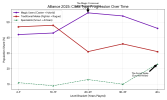
Based on the analysis, here is the visualization of the "Caster vs. Melee" progression.

This chart highlights a clear "Crossover Event" that occurs around the mid-game (Levels 20-29).

  • Traditional Melee (Fighter/Rogue): Starts as the dominant playstyle but enters a long-term decline.
  • Magic Users: Overtake Melee at Level 20 and remain the preferred choice for the rest of the game's lifespan.
  • Specialists (Scout/Artisan): Remain niche until the very end, where the "Scout Spike" drives a massive surge in the 40+ bracket.
1764784135307.png

Here is the chart showing the progression of class types over time.

Key Trends Visualized:
  • The Magic Crossover: Around level 20, Magic Users (purple line) overtake Traditional Melee (red line) in popularity, maintaining dominance through the endgame.
  • The Scout Spike: At the 40+ bracket, the Specialist line (green dashed) shoots upward, driven by the massive influx of Scouts.
  • Melee Decline: Traditional Melee classes see a significant drop in share as the years/levels progress.

Obviously this doesn't take Spirit Forges into account, but that can't easily/quickly be fed into the model. Anecdotally, I did browse through the new rituals for 2.1 thread yesterday, as well, and the vast majority did feel caster focused, which supports the takeaway above from Gemini of 'Magic is Essential' and that the idea of magic augmenting a class furthers its utility and function.

I'm not going to detail how long I've played, it's irrelevant. I hope to continue playing, as I hope many other will, and interest in keeping the numerous classes diverse and functional is the key to that, in my mind, but requires something more than hot-swapping a skill here or there, and I'm hoping that there's a plan beyond one skill or another being inconvenient to scaling at one time or another. So I'm asking the question in as diplomatic way as I can, knowing the propensity of forums and impersonal internet discussion to become toxic and derail quickly -- neither being my intention.

Anyways, this is already very long. TL;DR: Glad there's personal experiences, hoping there's a plan.
 
The AI analysis above missing some super key details. First, it treats all scholars as one lump, which is a misnomer. Second, without earth scholars/healing, events aren't successful as we need healing to keep things moving. Players know this, and more people play earth casters to account for this.

People at high levels go hybrid builds because that's where those builds actually work and feel good. Playing a level 10 spell sword is playing a level 3 fighter and a level 3 scholar, which just feels bad.

Npc for an event and take note of who deals the most damage to you. As someone who ran plot for years, I promise it is melee in almost all cases. Repetitive damage is how the game works.

Melee and earth scholars will continue to be the bread and butter that moves fights forward, losing EB will make no difference to that.
 
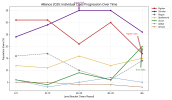
There are a lot of datapoints missing that could lead to a more accurate takeaway, this is using only classes by level bracket over time, as noted.

Assuming that every Earth-Primary is using every spell for Healing is fallacious, as well, given the inclusions of ability and rituals with 2.0-forward, and the various combined strike abilities -- these can just as easily be used as damage outputs. But again, this is just using class-by-level.

1764823493270.png

Again, the points I want to emphasize are that the playstyle experienced can and will change wildly by individual perspective. And that's fine. Believing, however, that a personal view will be the outcome for everyone is one of deep bias. I can tell you that your experience is not the same as mine.

My questions and concern as initially posed remains, because the trend is as concerning as it is puzzling for the most recent and drastic effect change.
 
You say things like 'fighter crash' and 'scout spike' but fail to take the next analytical step. The exact thing you are showing there is something many experienced players suggest other people do. Hell, two of my best friends who play this game (and played NERO for decades previously) did this exact thing.

Look at the trade offs: when going from fighter to scout at ~30th level, you give up some hit points and minor costs on your abilities to unlock a second set of abilities to take advantage of diminishing returns. Instead of only taking advantage of the DR on prof, you now take advantage of both prof and backstab (and combine them both when using archery). This literally has nothing to do with fighter being bad, it has everything to do with hybrid builds being viable late. Scout is still a fighter, they just get even more repetitive damage and dodges.

Also, if you are attempting to make an argument or question in good faith, please do not attempt to exaggerate the other argument. That is a logical fallacy. I never said earth casters used 100% of their spells on healing. I said that healing spells are required for the game to work. I also invited you to do an experiment to look closely for yourself how the actual breakdown plays and the actual truth of how the game works, not just accept my perspective or your viewpoint of how the game 'feels' to you.
 
This is interesting data analysis,


I do want to say though: fighter crash and scout spike are really just the natural progression of fighters at this point. At some point it just becomes more efficient from an xp perspective to buy backstabs for conditional repetitive damage compared to the price of unconditional repetitive damage.

They are still melee focused characters.

Right now there just isn't a compelling reason for fighters (and scholars) to stick with just scholarly or martial skills into the highest levels as they are often better off picking up something else to augment it.
 
I'm going to assume that the lateness of your reply is largely feeding into the tone I'm reading. The chart, and every note within it that you're noting, is from Gemini.

I am equally not looking to justify why people play Scouts, Scholars, or other classes, as noted in the original post.

The question is -- What is the plan, what is the intent long term, for the path of the Fighter class?
If:
  • Increased in core skill cost (Weapon Proficiency with 2.0)
  • Diminished in efficacy (Weapons in general in 2.1 being susceptible to Shatter etc.)
  • Minimal support in Ritual Magic (2.1 New Ritual thread)
  • Skills are going to be removed (Eviscerating Blow)
The Classes Played by Bracket data is used to reference -- over time -- the class is less desirable. If it is less desirable, then regardless of other classes being more desirable, it still means just that -- Fighters become less desirable over time. The question as to why that is, and where those players go is what typical game design would seek to answer.

This is not saying the class is unplayable. This is not saying the class has no worth. It is asking, with respect to the last several years of moves, what the plan is.
 
Maybe it would help to try and explain how I approach looking at our game's balance, because we have one very fundamental difference in our approach which is skewing the results.

In my view, our game has 5 primary skill sets, and then uses different combinations of costs on those skill sets to create the classes offered.

The skillsets are Martial, Stealth, Earth Magic, Celestial Magic, and Crafting.

With that said, we have 5 'Pure' classes (Fighter, Rogue, E scholar, C scholar, Artisan). All the others are hybrids.

In my opinion and experience, people generally feel unfinished if they choose to play a hybrid class before level 25ish, especially if they have similar level teammates playing a pure class. Knowing this, I generally suggest all new players pick one of those 5 (well, 4, as artisan is an acquired taste/style) until they feel content with their abilities in the original skillsets, the choose whether they want to continue or branch out.

With this in mind, I do not see someone going from fighter to scout as someone 'leaving' being a fighter, I see it as them branching out as they are content with what they have from the martial skillset. This is not a failure of the martial skillset, it is a feature of our system to make the secondary skillset worthwhile.
 
I don't disagree with that/those take(s) in principle having given similar advice to others starting to play, and my worry isn't a five-alarm "its broken and needs immediate fixing".

Even my own fighter is roughly a quarter of Rogue-skill XP spends, mostly because of failings in the Fighter skill tree around things that Counteract and Dodge resolve.

In my mind, Taunt feels weak for what its supposed to be replacing, for where its replacing. Eviscerating Blow, for me, was a "You'll pay attention to me, or else" skill, not necessarily a damage dealing skill.

I've said it somewhere in one of these posts, that Taunt feels very much like a comparison to the short-lived Terror (another Greater Command) "If you can't make something be afraid, here's a skill for it". Taunt is "If you can't make something pay attention to you, here's a skill". There are already skills, if you're already applying Destruction, Break, Repel, etc., while refusing to die from mitigation in front of something, if you're in the way of a creature's advance while a caster's behind or next to you drilling away a spell column, you're more effective than a ten second Taunt ever will be.

A thirty second "Root" (pin) would be better used, but that's just identical to a level 2 General spell at that point, still not befitting where Eviscerating Blow was.

But, if others are struggling with that, a skill to help them along with that, that's fine. I just want to know where we're going when things are taken away. "Yes and" not "No but".
 
Taking a different angle on the conversation, I would have liked to see taunt be less along the lines of controlling what something was doing and more along the lines of what you were saying (Do what I want you to do, or else).

I think it could have been fun to have taunt be something like:

Can only use offensive abilities against the person(s) who taunted you.
Take double damage from all other sources.
Calling a defense while taunted expends 2 charges of that defense (if only 1 charge remains, the defense cannot be used).
Duration: 10 seconds or line of sight, whichever comes first

This could help mitigate the confusion over charging/running through the line/running into a trap/being generally ignorant of your own safety (on a player and character level) and would incentivize them to kill the taunter to end the effect. If it causes the monster to flee the battlefield, that's fine as they are still controlled and not hitting my friends.

This version feels more straight forward/friendly (to me) when a PC gets hit with the effect. The current effect can easily lead to PC resurrections in some not-too-hard-to-set-up circumstances.

This would also help with the character design of a tank to not only absorb damage, but enable his team in a similar way that casters can with bindo.
 
I think that a combination of effects like (I think) you're detailing would make it more worthwhile.

Double Damage from other sources (Destruction)
Double-Defense Expenditure (as you listed)
Half-Damage against Taunt-User (Improved(?) Weakness)
Requirement: Shield (If you're a tank, act like one)

I'm not in love with a 10 second duration, it feels short when compared to something like Prison or any of the singular abilities, but don't have a better suggestion. Double duration listings can lead to confusion, especially when LoS is one of them, so I'm generally not a fan of those, personally.

Moving this to Eldritch Force effect group, like Subjugate, would also address a number of problems I'm waiting to see how they're resolved in final writeup if it stays as Greater Command.

A Shield/Melee requirement would address a lot of the range/charging issue that has come up with a lot of discussions, as you also highlighted.
 
Obviously, since we are trying to make fighters do less damage, they should be more useful outside of combat right? I think fighters should get an attack that makes plants grow faster or maybe an intimidate skill that forces someone to tell everything they know about the history of an object or person.
 
I understand you may be upset with the decision, but that isn't helping to elicit positive change.
 
Sorry, I use humor to highlight the absurdity of certain arguments.

Fighters only do one thing, fight. Up front, they should do the most damage and take the most damage because they will be taking the most damage. If other classes are complaining that their damage is overshadowed by Fighter damage and there needs to be more balance, then we need to also balance fighters around all the other aspects of the game that do no relate to fighting.
 
I understand. Can you give some examples of the other skills that classes have access to outside of fighting that you are referring to?

Even with this change, melee/weapons still do a majority of the raw damage in the game due to the unlimited repetitive passives they have access to.
 
I understand. Can you give some examples of the other skills that classes have access to outside of fighting that you are referring to?

Even with this change, melee/weapons still do a majority of the raw damage in the game due to the unlimited repetitive passives they have access to.
Most of the mechanics of the non-combat game is locked behind ritual magic. Lores, seek the whole, summoning, bountiful harvest, etc. There is a little in crafting, but I don't think artisan focused characters are complaining about their damage output compared to other classes. Rogues I suppose get easy access to traps and poisoning, it's not much, but they seem to have fun going through fishing line activated trapped rooms or trying to slip a poison into someone's drink, heh.

Of course, my argument is not that fighters should have these things, but that balancing around damage ignores the variety that other classes have. You may not be able to do as much damage to the BBEG as a fighter, but you can triple the harvest of crops in an area or summon anyone willing from anywhere to you. I understand that Alliance is primarily focused on combat, but it seems like there is an effort to address that, which I think is a great thing. There are plenty of larps where combat is not the primary focus and Alliance would probably have more success if there were more things to do, (with mechanics in the rule book), for people who lean towards non-combat.
 
I see your point and agree, but also agree that our particular game/system is built around the combat side with those RP skills being a long afterthought (we aren't Dystopia Rising with social combat and gathering being main archetypes).

Do you have ideas on what type of skills or abilities you'd like to see for the martial archetypes in that regard?

We ran a variant on tracking (I know, everyone's favorite profession skill) to try and address something along these lines. We represented tracks with poker chips (white, red, blue, and black) and allowed different levels of the tracking skill to interact with the different colors (i.e. level 1 can see white but can't follow, level 2 can follow white, level 3 can see red, etc) and it had some potential, but had its issues.
 
Back
Top